-1.png)





.png?width=2000&height=1368&name=ai-remediation%20(1).png "ai-remediation (1)")


FAQ:
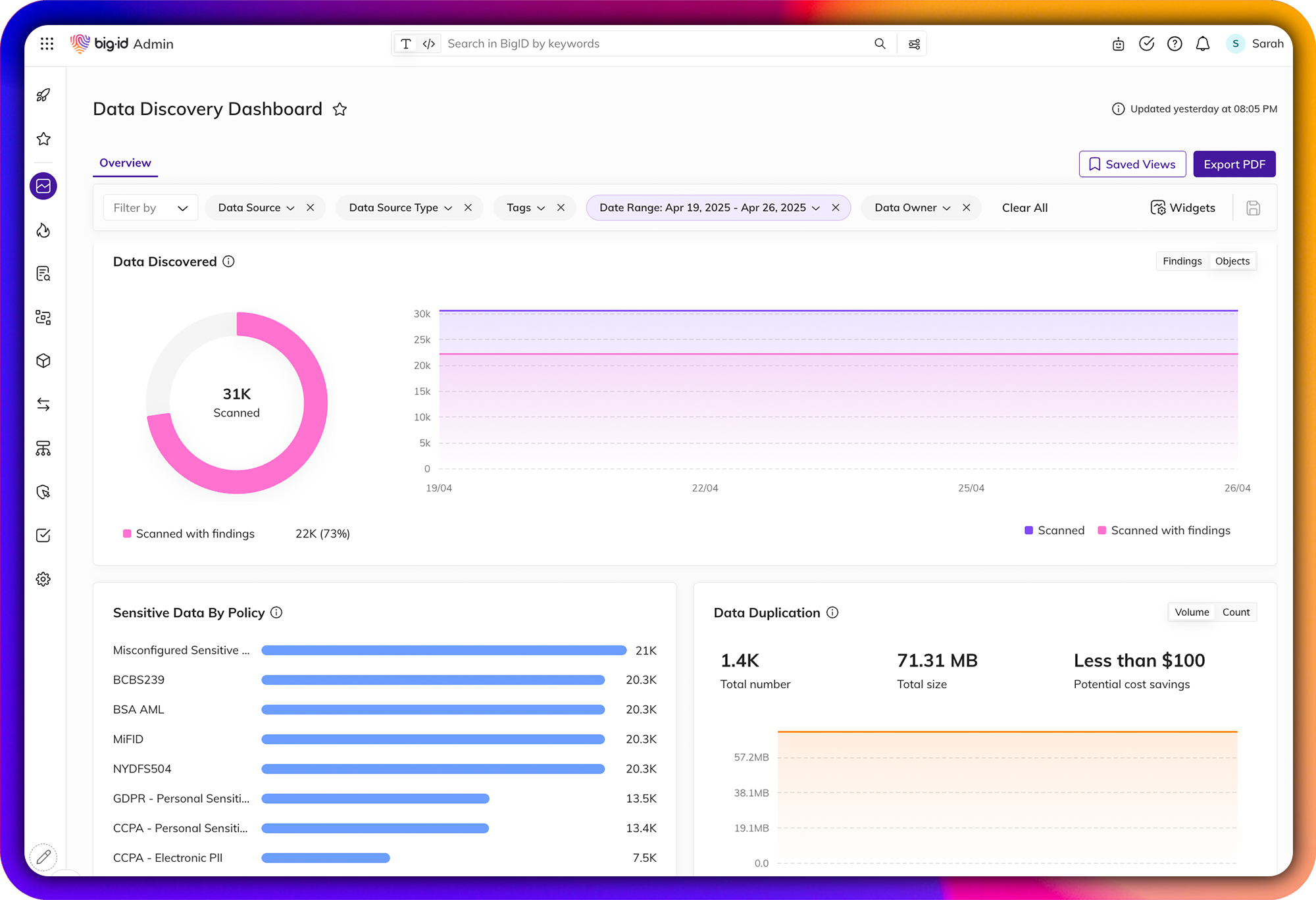
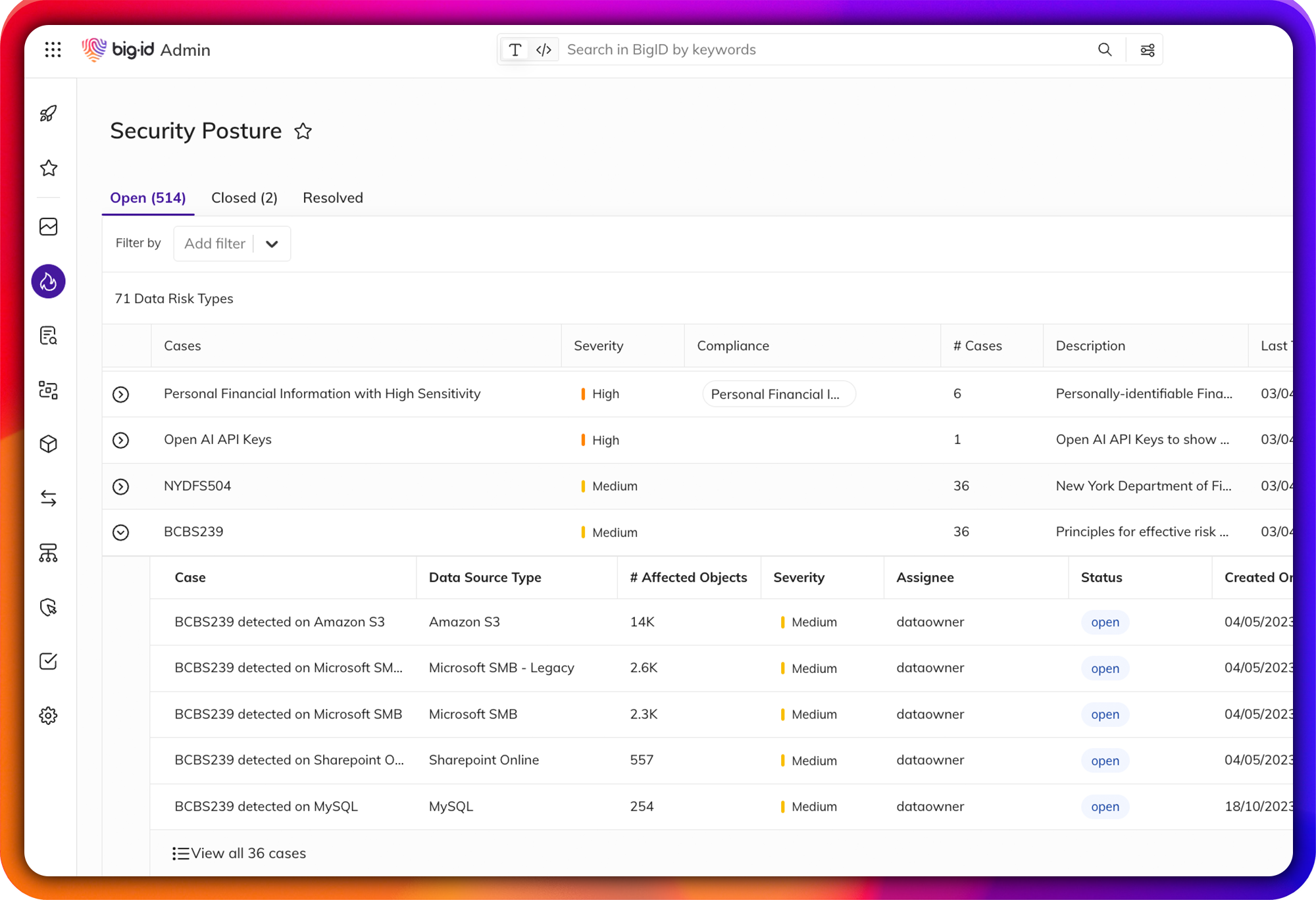
What is data security posture management (DSPM)? Data security posture management (DSPM) is a category of security technology that gives organizations continuous visibility into where sensitive data lives, who has access to it, and where it is at risk, across cloud, on-prem, and hybrid environments. DSPM platforms like BigID automatically discover, classify, and assess data risk so security teams can prioritize and remediate vulnerabilities before they lead to breaches.
How does BigID support AI governance? BigID's AI governance capabilities help organizations control the data that enters and exits AI models. This includes discovering and classifying sensitive data in LLM training sets, identifying over-exposed records in AI pipelines, flagging shadow AI usage, and enforcing data-use policies to reduce AI risk. BigID also supports compliance with emerging AI regulations including the EU AI Act and NIST AI Risk Management Framework.
What is the difference between BigID and legacy DLP tools? Traditional DLP tools rely on static rules and pattern-matching that miss large portions of sensitive data, especially in unstructured files, cloud environments, and modern SaaS platforms. BigID uses ML-driven discovery and classification to scan data 95% faster, with significantly fewer false positives. Unlike legacy DLP, BigID provides full data context — who owns it, who can access it, and what risk it carries — enabling smarter, automated remediation across your entire data landscape.
What is AI security risk and how does BigID address it? AI security risk refers to the threats that arise when sensitive, regulated, or confidential data enters AI training pipelines, model inputs, or AI-generated outputs without proper governance. BigID addresses AI security risk by identifying high-risk data before it reaches AI systems, monitoring data flows into LLMs, and enabling security teams to enforce least-privilege access policies across AI infrastructure.
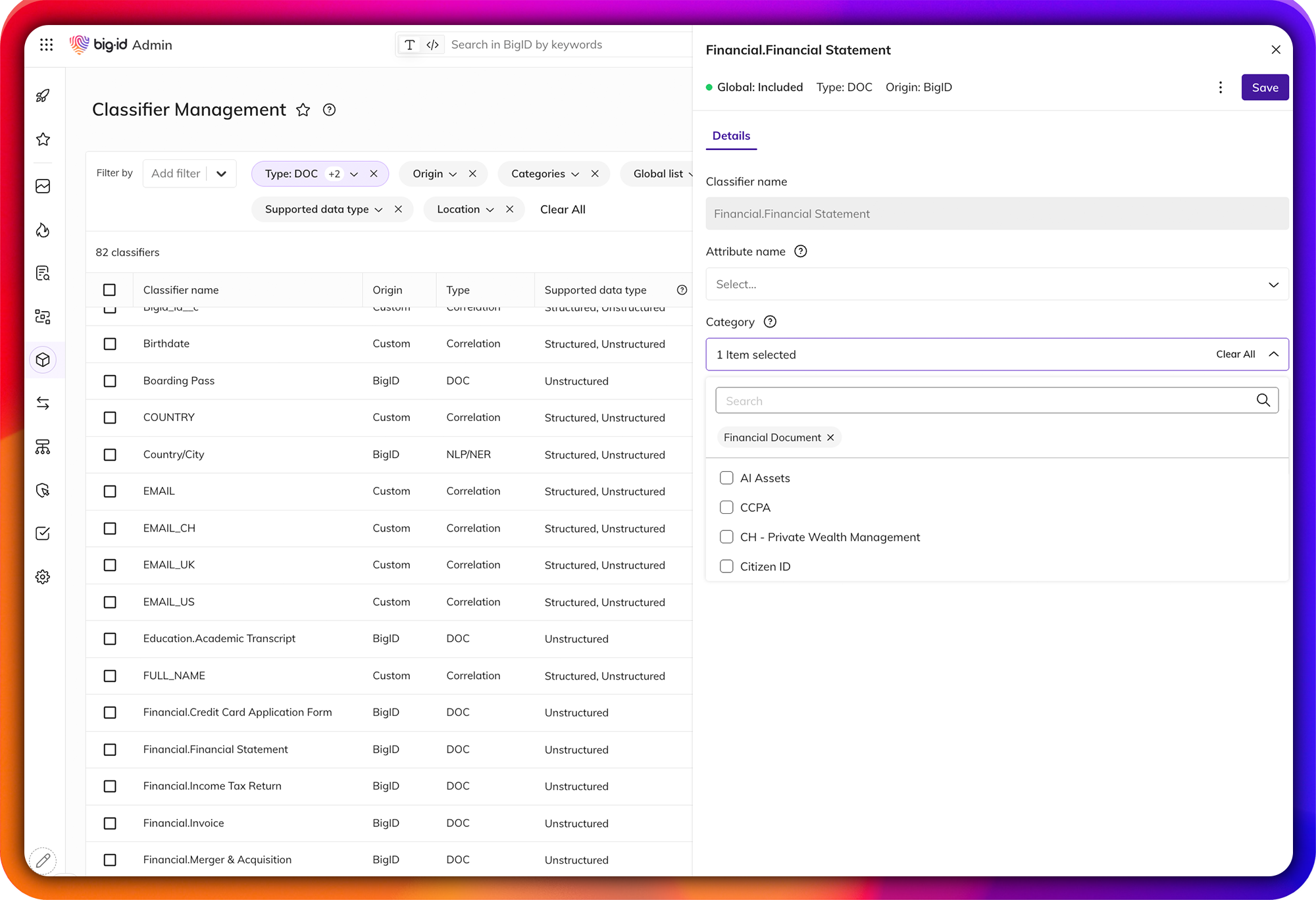
What data classification capabilities does BigID offer? BigID provides ML and NLP-based data classification across structured and unstructured data, spanning cloud storage, databases, SaaS applications, email, and on-prem systems. Organizations can use built-in classifiers for PII, financial data, health records, credentials, and IP, or build custom classifiers trained on their own data. A unified classification ruleset ensures consistent labeling and tagging across your entire data environment.