The CISO’s Guide to AI Security
Artificial intelligence is reshaping cybersecurity, but for CISOs, the hype often outpaces the reality. AI is frequently hailed as the solution to every security challenge, from anomaly detection to threat response. But like any tool, its effectiveness depends on how you approach it, where you apply it, and how you manage expectations. AI has its own limitations and vulnerabilities, and it can be exploited.
This guide cuts through the noise and gives CISOs a practical, skepticism-informed playbook for leveraging AI where it delivers the highest security value: reducing false positives, securing data in LLM pipelines, and uncovering the dark and shadow data that puts your organization at risk.
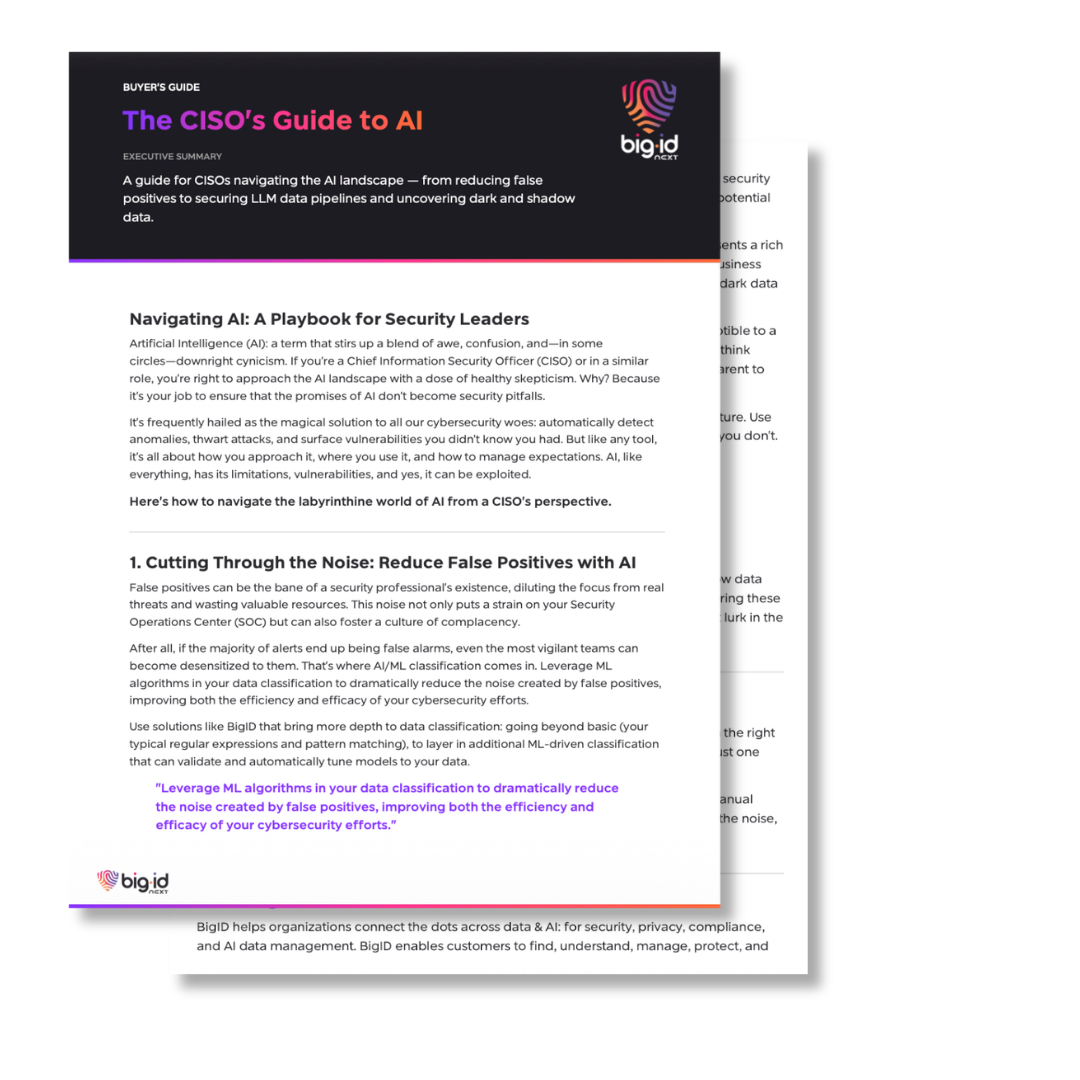
Recognized as the #1 data security, privacy, and AI data management solution





What Is AI-Driven Data Security?
AI-driven data security is the application of machine learning (ML), natural language processing (NLP), and other AI techniques to automate and improve data discovery, classification, risk assessment, and remediation across an organization’s data landscape.
For CISOs, AI-driven data security addresses three persistent challenges that legacy tools struggle with: the volume of false positives that overwhelm security operations, the growing risk of sensitive data entering LLM and generative AI pipelines without proper governance, and the proliferation of dark and shadow data that exists outside the visibility of traditional security controls.
AI-driven data security does not replace existing security infrastructure. It enhances it by adding ML-powered classification, automated data inventory, and AI-prioritized risk remediation to the data security stack.
Guide Preview: 3 Ways to Leverage AI for Data Security
1. Cut Through the Noise: Reduce False Positives with AI
False positives are one of the most persistent operational challenges in data security. ML-driven data classification changes this equation. By going beyond basic regular expressions (RegEx) and pattern-matching, ML algorithms learn the patterns in your specific data environment and continuously improve accuracy over time. This dramatically reduces false positive rates while increasing the signal-to-noise ratio of your classification results.
BigID leads the market in ML-driven data classification that is accurate, tunable, and actionable. Organizations can layer advanced ML and NLP-based classifiers on top of traditional approaches, validate results automatically, and fine-tune models to their own data, turning a flood of false alarms into a focused stream of meaningful, actionable alerts.
2. Secure Sensitive Data in LLM and Generative AI Pipelines
The rise of large language models (LLMs) like ChatGPT and enterprise AI copilots has created a new category of data security risk.
Before employing LLMs for any task, whether customer service automation, data analytics, or threat detection, CISOs need robust data handling procedures in place. The critical first step is identifying and classifying the data that might enter AI systems.
BigID’s AI-driven classification enables organizations to scan, classify, and validate that data in LLM pipelines is fit for purpose, reducing the likelihood of data breaches, data leaks, and compliance violations. As organizations increasingly rely on generative AI, the data that powers these tools must be handled with an equal measure of sophistication and control.
3. Shine a Light on Dark and Shadow Data
Dark data is data that exists in your environment but is unknown, poorly inventoried, and outside active security monitoring. Shadow data is data that has been copied, moved, or created outside your organization’s sanctioned security controls, often by employees using unsanctioned applications or workflows. Together, they exponentially amplify your risk: you cannot protect what you do not know about.
BigID uses AI to automatically uncover and inventory both the data you know about and the data you don’t.
How to Adopt AI into your Data Security Strategy
A Defense-in-Depth Approach to AI-Powered Data Security
AI is not a silver bullet. Its effectiveness in cybersecurity depends on how well it is applied within a broader security strategy. The most effective approach is defense-in-depth: layering AI-powered capabilities (ML-driven classification, automated discovery, AI-prioritized remediation) on top of existing security infrastructure to improve accuracy, automate manual processes, and strengthen your data security posture.
BigID takes this defense-in-depth approach, combining advanced data discovery and classification with remediation workflows, access intelligence, and policy enforcement across 500+ data sources, from cloud to on-prem to everywhere in between.
FAQ:
How does AI reduce false positives in data security?
Traditional data classification tools rely on regular expressions (RegEx) and pattern-matching, which generate high volumes of false positives, especially in unstructured data. ML-driven classification learns the patterns in your specific data environment and continuously improves accuracy over time. This reduces false positive rates while increasing the signal-to-noise ratio, allowing security teams to focus on real threats instead of chasing false alarms. BigID’s ML-driven classification is ranked #1 in accuracy by Intuit.
How should CISOs secure data in LLM and generative AI pipelines?
CISOs should implement robust data handling procedures before any data enters LLM or generative AI systems. This includes: (1) discovering and classifying all data that could enter AI pipelines, (2) flagging and tagging PII, confidential business plans, regulated material, and credentials, (3) validating that data in LLM training sets is fit for purpose, and (4) continuously monitoring data flows into and out of AI models. BigID’s AI-driven classification automates this process across structured and unstructured data at scale.
What is dark data and why is it a security risk? Dark data is data that exists in an organization’s environment but is unknown, poorly inventoried, and not actively monitored by security controls. It often contains sensitive personal information, confidential business strategies, or intellectual property. Because dark data is not monitored, breaches involving dark data frequently go unnoticed until significant damage has occurred. Dark data is one of the largest sources of enterprise data risk because you cannot protect data you do not know about.
What is shadow data and how does it differ from dark data?
Shadow data is data that has been copied, moved, or created outside an organization’s sanctioned security controls, typically when employees use unsanctioned applications or workflows. While dark data is data you don’t know about, shadow data is data that exists in places your security tools don’t monitor. Shadow data bypasses security controls entirely, making it vulnerable to data corruption, phishing attacks, and unauthorized access. Both dark and shadow data amplify risk and require automated discovery to manage effectively.
What is AI-driven data classification?
AI-driven data classification uses machine learning (ML) and natural language processing (NLP) to automatically categorize data by type, sensitivity, and risk level across an organization’s data landscape. Unlike traditional RegEx and pattern-matching approaches, ML-driven classification learns from your specific data environment, handles unstructured data more effectively, and continuously improves accuracy over time. BigID’s ML and NLP-based classifiers can be trained on custom data, fine-tuned before deployment, and applied through a single unified ruleset across all data sources.