CHECKLIST

The Ultimate Data Security Posture Management (DSPM) & AI Security Checklist for CISOs

Modern enterprises face an explosion of sensitive data, shadow AI, and rising security risk across multi-cloud and hybrid environments. Data security posture management (DSPM) has emerged as the essential discipline for CISOs who need continuous visibility into where sensitive data lives, who has access to it, and where it is at risk.

This checklist gives CISOs and security leaders a clear, actionable framework to evaluate DSPM and AI security posture management (AI SPM) platforms — and avoid the most common pitfalls that derail data security programs.

What’s Inside:

  • The 10 biggest DSPM challenges facing security teams today and how industry leaders are solving them
  • Must-have DSPM capabilities for scalable, modern data security: discovery, classification, access intelligence, and automated remediation
  • How DSPM and AI SPM work together to protect prompts, training data, AI pipelines, and models from sensitive data exposure
  • The top vendor evaluation questions every security team should ask before selecting a DSPM platform

Download the checklist to benchmark your organization’s data security posture and build a roadmap for DSPM and AI SPM success.
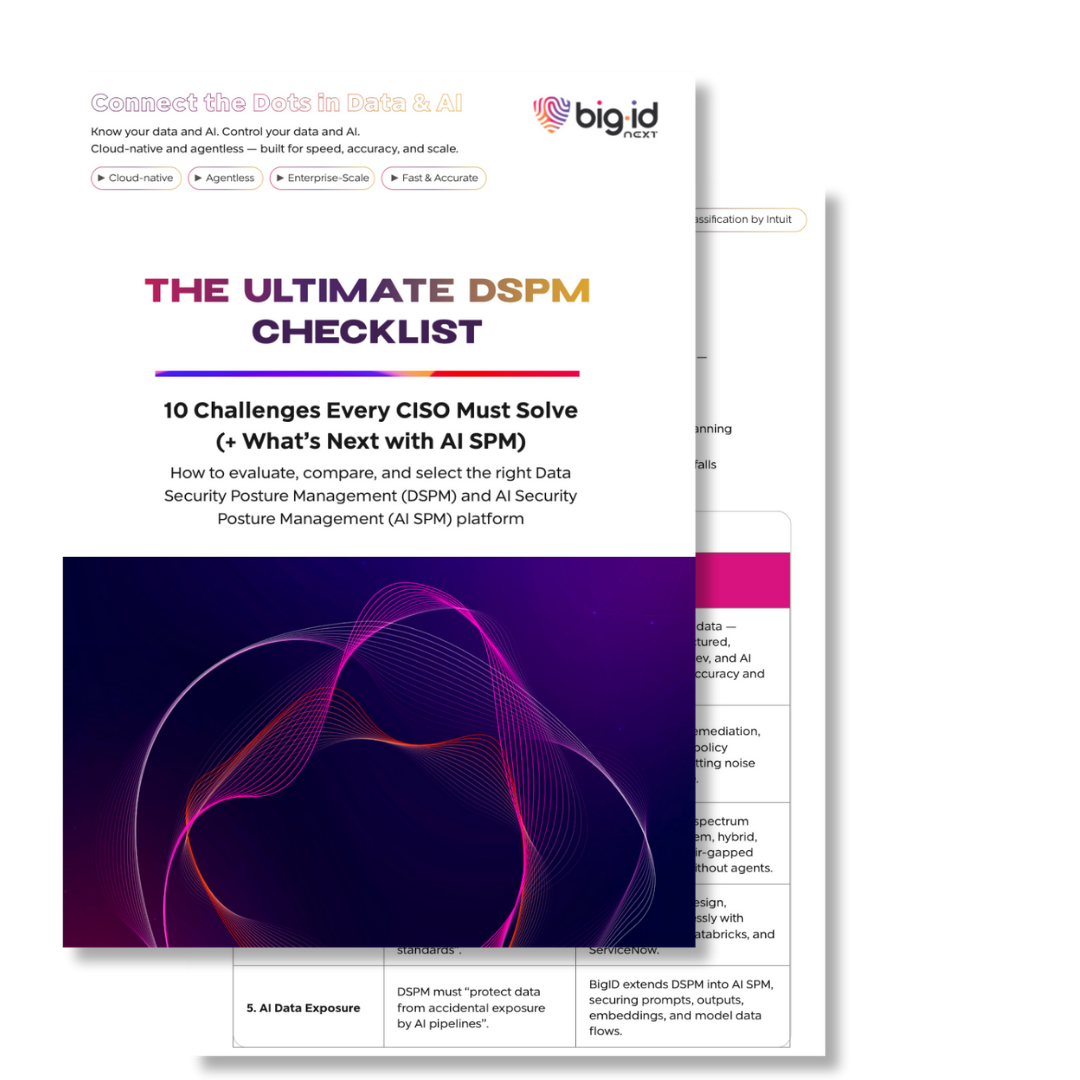

ultimate dspm checklist

Recognized as the #1 industry-leading data security, privacy, and AI data management solution by leading analysts and industry publications.

What is Data Security Posture Management (DSPM)?

Data security posture management (DSPM) is a category of security technology that gives organizations continuous, automated visibility into where sensitive data lives, who has access to it, how it is being used, and where it is at risk across cloud, on-premises, SaaS, and hybrid environments.

Unlike traditional data loss prevention (DLP) tools that rely on static rules and perimeter-based controls, DSPM platforms use machine learning-driven discovery and classification to automatically find and assess sensitive data at scale. DSPM enables security teams to prioritize and remediate data vulnerabilities before they lead to breaches, regulatory penalties, or compliance failures.

DSPM has become a foundational capability for CISOs managing data security in multi-cloud environments, where sensitive data proliferates across hundreds of data stores, SaaS applications, and AI pipelines that legacy tools were never designed to monitor.

What Is AI Security Posture Management (AI SPM)?

AI security posture management (AI SPM) extends the principles of DSPM to the AI layer, providing visibility and governance over the data that enters and exits AI models, LLMs, and generative AI pipelines.

As enterprises deploy AI tools at scale, sensitive data frequently enters training datasets, prompt contexts, and model outputs without proper controls. AI SPM platforms help security teams discover what data is flowing into AI systems, classify its sensitivity, enforce data-use policies, and detect shadow AI usage, reducing the risk of data leakage, regulatory non-compliance, and AI-driven security incidents.

Together, DSPM and AI SPM give CISOs a unified approach to securing both their data estate and their AI infrastructure.

The DSPM Imperative: Why CISOs Can’t Wait

  • Data sprawl is accelerating: The average enterprise manages data across hundreds of cloud services, SaaS platforms, and on-prem systems, with sensitive data scattered across locations that security teams don’t know about.
  • Shadow AI is the new shadow IT: Employees are using unsanctioned AI tools with corporate data, creating ungoverned data flows that bypass existing security controls.
  • Regulations are tightening: The EU AI Act, GDPR enforcement actions, DORA, and evolving US state privacy laws are raising the bar for data security accountability.
  • Legacy DLP is failing: Traditional DLP tools miss large volumes of sensitive data in unstructured files, cloud-native storage, and modern SaaS environments, leaving critical gaps in your security posture.

A structured DSPM checklist helps CISOs cut through vendor noise, focus on what matters, and build a data security program that scales with the business.

FAQ:

What is data security posture management (DSPM)?
Data security posture management (DSPM) is a category of security technology that provides organizations with continuous, automated visibility into where sensitive data lives, who has access to it, and where it is at risk across cloud, on-premises, and hybrid environments. DSPM platforms like BigID use machine learning to automatically discover, classify, and assess data risk so security teams can prioritize and remediate vulnerabilities before they lead to breaches or compliance failures.

What is AI security posture management (AI SPM)?
AI security posture management (AI SPM) extends DSPM principles to the AI layer, providing visibility and governance over the data entering and exiting AI models, LLMs, and generative AI pipelines. AI SPM helps organizations discover sensitive data in AI training sets, enforce data-use policies, detect shadow AI usage, and reduce the risk of data leakage through AI systems.

How do DSPM and AI SPM work together?
DSPM provides the foundational data discovery, classification, and risk assessment capabilities that security teams need across their entire data estate. AI SPM builds on this foundation by extending the same visibility and governance controls to AI-specific data flows, including training data, prompt inputs, and model outputs. Together, they give CISOs a unified approach to securing both traditional data infrastructure and modern AI systems.

What should CISOs look for in a DSPM platform?
CISOs evaluating DSPM platforms should look for: ML-driven data discovery and classification (not just RegEx), broad data source coverage (500+ connectors across cloud, SaaS, and on-prem), automated remediation workflows, zero trust access intelligence, AI security posture management capabilities, and compliance mapping to major regulatory frameworks including GDPR, CCPA/CPRA, HIPAA, and the EU AI Act. The best DSPM platforms provide continuous visibility, not point-in-time snapshots.

What is the difference between DSPM and traditional DLP?
Traditional DLP tools rely on static rules and pattern-matching to prevent data loss at network boundaries. They often miss large volumes of sensitive data, especially in unstructured files, cloud-native environments, and modern SaaS platforms. DSPM takes a data-centric approach: using ML-driven discovery to find all sensitive data, continuously assessing risk posture, and providing full data context (ownership, access, regulatory obligations) to enable smarter, automated remediation. DSPM is proactive; legacy DLP is reactive.

Get the Checklist